

Introduction
Navigating the regulatory landscape for medical devices in India can be complex. One of the most strategic tools provided by the Ministry of Health and Family Welfare (MoHFW) under the Medical Devices Rules, 2017 is the ability to "group" products for licensing.
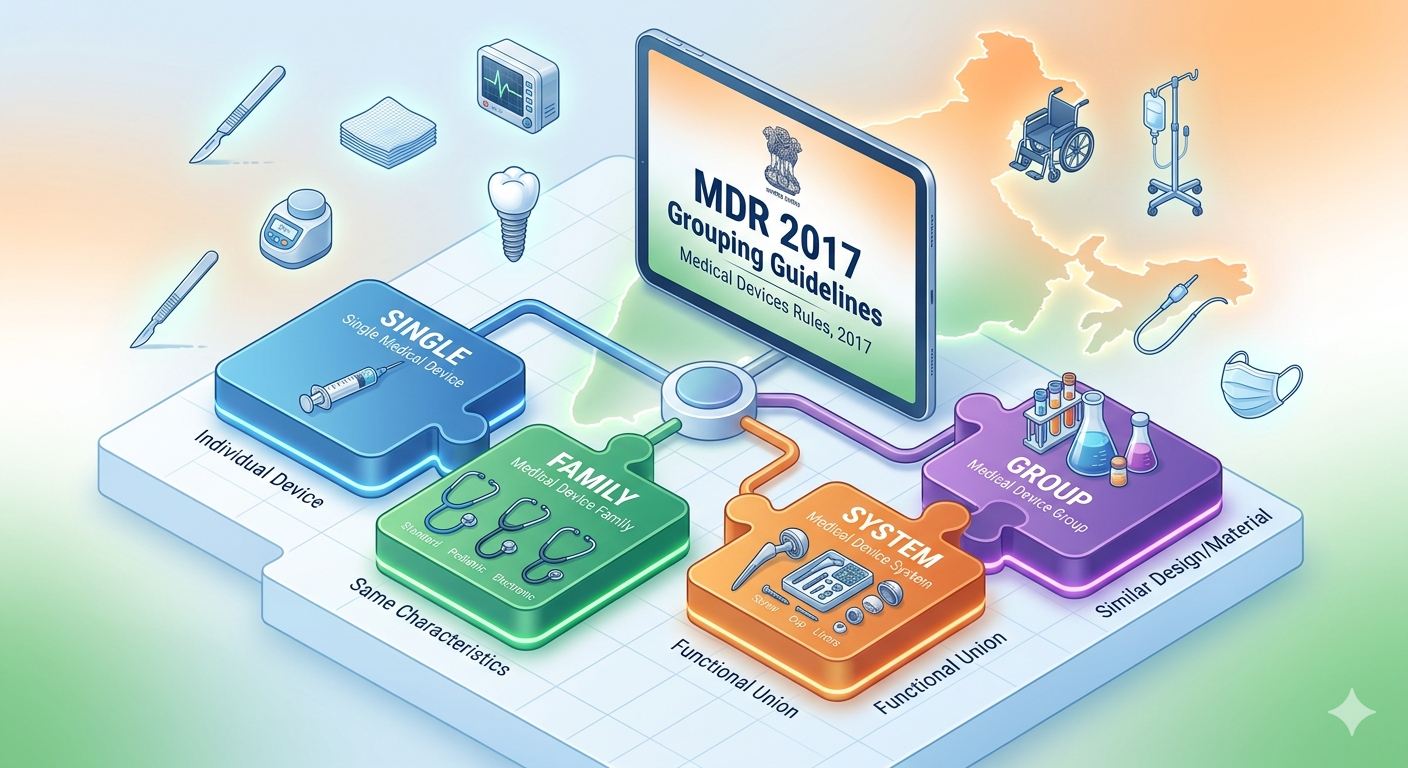
The Grouping Guidelines for Medical Devices Applications Issued in March 2018, allow manufacturers and importers to save time and reduce regulatory burdens by submitting a single application for multiple products that share common characteristics.
In this blog, we break down the six grouping categories - Single, Family, System, Group, IVD Test Kit, and IVD Cluster and most importantly, clarify the Fee and Documentation requirements for each.
Why Grouping Matters
Submitting a separate application for every single variant of a product (like different sizes of condoms or colors of gloves) would be inefficient. Grouping allows you to combine similar products under one umbrella, provided they meet specific criteria. This leads to:
- Reduced Licensing Fees: Pay one fee instead of many.
- Streamlined Documentation: Submit one common Master File instead of repetitive paperwork.
- Faster Approvals: Easier review for regulators when products are logically grouped.
Part 1: Grouping for Medical Devices (Non-IVDs)
Here is how the guidelines apply to devices like catheters, implants, gloves, and first-aid kits.
1. Single Device
- Criteria:
- Sold as a distinct packaged entity.
- Does not meet the criteria for a Family, System, or Group.
- Fees & Documents:
- Fee: Separate fee for each single device.
- Documents: Separate documentation for each single device.
- Example: A specific model of a thermometer sold individually.
2. Family
- Criteria:
- Same license holder.
- Same risk classification (Class A, B, C, or D).
- Common intended use.
- Same design and manufacturing process.
- Variations are within "permissible variants" (e.g., size, color, length).
- Fees & Documents:
- Fee:Single fee for the entire family.
- Documents:Common DMF (Device Master File) covering all variants.
- Examples:
- Condoms differing in color, size, and texture (same material/process).
- IV administration sets with different tubing lengths or safety wings.
- Cardiac catheters with different lumen counts or diameters.
Note: Toric and Spherical contact lenses have different designs/intended uses, so they cannot be in the same family.
3. System
- Criteria:
- Same license holder.
- Intended to be used in combination for a specific purpose.
- Compatible when used together.
- Sold under a single proprietary System name.
- Fees & Documents:
- Scenario A (Sold only as a Single Unit Pack/Kit):
- Fee: Single fee for the System.
- Documents: Separate documentation for each component.
- Scenario B (Sold as a Unit Pack AND/OR as individual components):
- Fee: Separate fee for each component.
- Documents: Separate documentation for each component.
- Example: A hip replacement system (femoral + acetabular components) or a glucose monitoring system (meter + strips + solutions).
4. Group
- Criteria:
- Collection of two or more devices (can be from different manufacturers).
- Assembled by a single product owner.
- Supplied in a single package.
- Single proprietary Group name and common intended use.
- Fees & Documents:
- Fee:Single fee.
- Documents: Documentation required for each medical device in the group.
- Example: A first aid kit containing bandages, gauzes, drapes, and a thermometer.
Part 2: Grouping for In-Vitro Diagnostics (IVDs)
IVDs have specific categories due to the nature of reagents and test kits.
1. Single Device (IVD)
- Criteria: A distinct packaged entity not meeting kit or cluster criteria.
- Fees & Documents: Separate fee and documentation.
2. IVD Test Kit
- Criteria:
- Same license holder.
- Reagents/articles used in combination for a specific purpose.
- Compatible when used as a kit.
- Sold under a single proprietary Test Kit name.
- Fees & Documents:
- Scenario A (Sold only as a complete Kit):
- Fee: Single fee for the kit.
- Documents: Separate documentation for each constituent (e.g., controls, buffers).
- Scenario B (Sold as a Kit AND/OR as individual replacement items):
- Fee: Separate fee for each constituent.
- Documents: Separate documentation for each constituent.
- Example: HIV ELISA Test Kit (containing controls, calibrators, washing buffers).
3. IVD Cluster
- Criteria:
- Same license holder.
- Common methodology (but may have different intended uses).
- Sold under a single proprietary name.
- Compatible when used as a test kit.
- Fees & Documents:
- Fee:Separate fee for each product within the cluster.
- Documents: Common DMF, but details of each product must be registered.
- Note: A cluster is like a "family" for IVD reagents sharing a technology platform.
4. Group (IVD)
- Applicability:Not applicable to IVDs.
Key Takeaways for Applicants
- Strategic Filing: If you manufacture syringes in 3ml and 5ml sizes with the same materials and process, file them as a Family to save costs.
- Beware of "Single" Sales: If you plan to sell components of a kit individually, you must pay separate fees and get separate licenses for those components.
- Documentation is King: Even when paying a single fee (like for a System or Group), you must still provide technical documentation for every individual component.
- Permissible Variants: Use the extensive list provided in the guidelines (see below) to check if your product variations (like coated vs. non-coated guidewires, or cuff vs. cuff-less tracheal tubes) qualify for a Family license.
Simplify Your Grouping Strategy with Satori One Click Solutions LLP
Feeling overwhelmed by the paperwork? You don’t have to do it alone.
At SatoriOCS, we understand that getting your grouping strategy right is the difference between a fast, cost-effective approval and months of regulatory back-and-forth. Whether you are trying to determine if your product line qualifies as a "Family" or need help preparing the Common DMF and separate component documentation for a "System," our team of expert regulatory consultants is here to help.
Why choose SatoriOCS?
- Expertise: Deep knowledge of the MoHFW 2018 guidelines and MDR 2017.
- End-to-End Support: From grouping strategy to fee calculation and documentation.
- Custom Solutions: We help you decide whether to file as a kit or as individual components to save the most on licensing fees.