

A Class C & D manufacturing licence is mandatory if you plan to manufacture moderate-high or high-risk medical devices in India under the Medical Devices Rules, 2017 (MDR 2017). These devices are regulated by the Central Licensing Authority (CLA) under CDSCO.
This detailed guide covers the entire process — from classification to licence grant — so you can apply correctly and avoid common rejections.
What Devices Need a Class C & D Manufacturing Licence?
Class C devices are moderate-high risk and Class D devices are high risk. Common examples include:
- Ventilators and anaesthesia machines
- Infusion pumps and dialysis equipment
- Orthopaedic implants and bone fixation devices
- Cardiac stents, pacemakers and heart valves
- Intraocular lenses and cochlear implants
- High-risk catheters and implantable devices
- Advanced diagnostic imaging systems
The exact classification is decided based on the parameters given in the First Schedule of MDR 2017 and the latest CDSCO Class-wise list.
Who Grants the Class C & D Manufacturing Licence?
- Authority: Central Licensing Authority (Drugs Controller General of India / CDSCO)
- Application Form: Form MD-7 (regular licence) or Form MD-8 (Loan Licence)
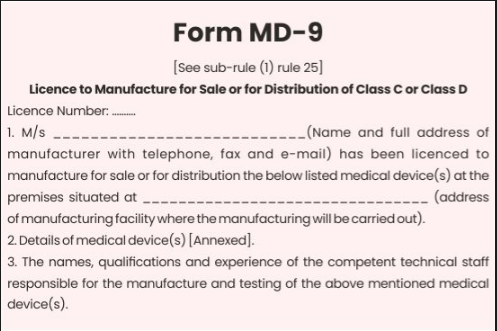
- Licence Issued in: Form MD-9 (regular) or Form MD-10 (Loan Licence)
Step-by-Step Process to Get Class C & D Manufacturing Licence
Class C & D Manufacturing Licence Process Flowchart
Step 1: Confirm Device Classification
Verify that your device is Class C or Class D using the CDSCO Class-wise list and First Schedule parameters. Wrong classification is one of the most common reasons for rejection.
Step 2: Ensure Quality Management System (QMS) Compliance
Your manufacturing site must comply with the Quality Management System requirements specified in the Fifth Schedule of MDR 2017. Most manufacturers implement ISO 13485:2016 as it aligns closely with these requirements. For Class C and D devices, the QMS requirements are more stringent.
Step 3: Appoint Competent Technical Staff
You must appoint:
- Manufacturing in-charge: Degree in relevant Engineering / Pharmacy / Science + 2 years experience or Diploma + 4 years experience
- Testing in-charge: Degree / Diploma in relevant field + minimum 2 years testing experience
Step 4: Prepare Required Documents
Key documents for your Class C & D manufacturing licence application include:
- Covering letter
- Duly filled Form MD-7 / MD-8
- Constitution documents of the firm
- Site / Plant Master File (Appendix I of Fourth Schedule)
- Device Master File (Appendix II or III of Fourth Schedule)
- Essential Principles Checklist
- Undertaking for QMS compliance (Fifth Schedule)
- Layout of manufacturing premises
- List of equipment and instruments
- Details of technical staff with qualification and experience
- ISO 13485 certificate (highly recommended)
- Stability data / performance evaluation reports (as applicable)
- Fee challan
Step 5: Submit Online Application
Submit the application through the CDSCO online portal along with the prescribed fee to the Central Licensing Authority.
Step 6: Site Inspection / Audit
For Class C and D devices, the manufacturing site is inspected by Medical Device Officers or officers designated by the Central Licensing Authority to verify QMS compliance and manufacturing capability.
- Inspection is more detailed compared to Class A and B devices
- Focus is on design controls, risk management, process validation and post-market systems
Step 7: Scrutiny & Grant of Licence
The Central Licensing Authority scrutinises the documents and inspection report. If everything is satisfactory, the Class C or D manufacturing licence is granted in Form MD-9 (or MD-10 for loan licence).
Important Timelines for Class C & D Manufacturing Licence
| Activity | Timeline |
|---|---|
| Document scrutiny | As per Central Licensing Authority |
| Site inspection / audit | As scheduled by CDSCO |
| Inspection report submission | Within prescribed timeline after inspection |
| Licence grant after satisfactory report | As per CLA decision |
Class C & D Manufacturing Licence Validity & Retention Fee
The licence remains valid in perpetuity, subject to payment of licence retention fee every 5 years as specified in the Second Schedule of MDR 2017.
Common Reasons for Class C & D Manufacturing Licence Rejection
- Incomplete or incorrect Device Master File / Plant Master File
- Non-compliance with Fifth Schedule (QMS)
- Lack of qualified technical staff
- Improper classification of device
- Incomplete Essential Principles Checklist
- Insufficient design control or risk management documentation
- Gaps in process validation or stability data
Class C & D Manufacturing Licence FAQs
Who issues the Class C & D manufacturing licence?
The Central Licensing Authority (CDSCO) issues it in Form MD-9, or MD-10 for a loan licence.
Is Notified Body audit mandatory for Class C & D?
For Class C and D devices, the inspection is primarily conducted by officers of the Central Licensing Authority. The process is more rigorous than Class B.
Can I apply for both Class C and Class D devices in one application?
Yes, provided the devices can be grouped as per the medical device grouping guidelines and are manufactured at the same site under the same Quality Management System.
How Satori OCS Can Help You
Navigating the Class C & D manufacturing licence process requires accurate documentation, robust QMS implementation, and proper coordination with the Central Licensing Authority.
At Satori One Click Solutions (Satori OCS), we provide end-to-end support for medical device manufacturers, including:
- Device classification support
- Preparation of Plant Master File & Device Master File
- QMS (ISO 13485) gap assessment and implementation
- Complete documentation for Form MD-7 / MD-9
- Risk management and design control documentation support
- Liaison with Central Licensing Authority / CDSCO
We have successfully helped multiple clients obtain manufacturing and import licences under MDR 2017.
Need Expert Assistance for Your Class C & D Manufacturing Licence?
Visit our Medical Devices Licensing page or schedule a free consultation with our experts.
Medical Devices Licensing in India
Email: satoriocs@gmail.com
Phone: +91 98290 98077