
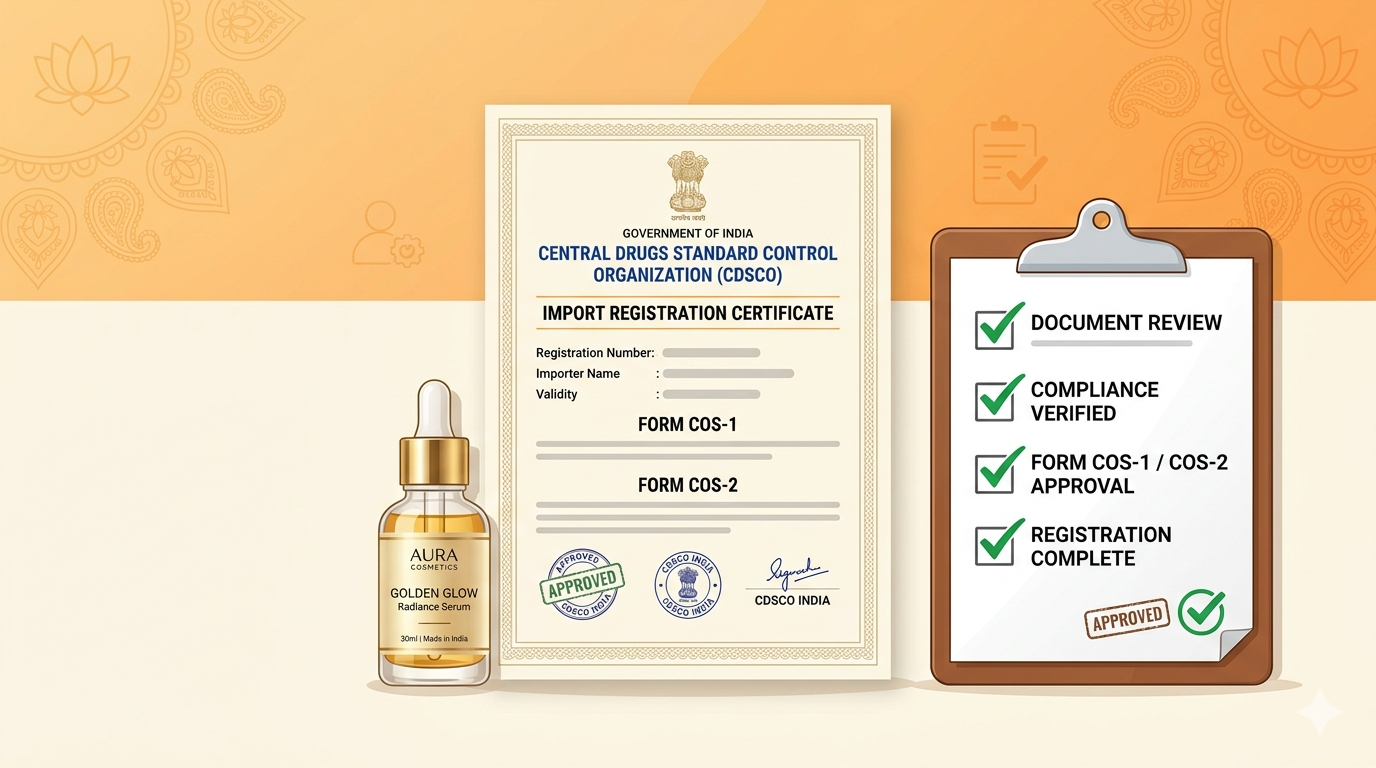

Do you want to import your foreign cosmetics brand into India? From CDSCO registration to filling out Form COS-1 here is the complete truth, straight and simple.
1. What is CDSCO and Why Does It Control Cosmetics?
Before importing any cosmetics into India, there is one name you need to understand: CDSCO — Central Drugs Standard Control Organisation.
CDSCO is a regulatory body under the Ministry of Health and Family Welfare that ensures the quality, safety, and compliance of both drugs and cosmetics. In the context of cosmetics, CDSCO is India's Central Licensing Authority — and the Drugs Controller General of India (DCGI) acts as the Central Licensing Authority.
If you want to import any foreign cosmetic brand into India — whether it is Korean skincare, French perfume, or any international beauty product — then obtaining an Import Registration Certificate (IRC) from CDSCO is mandatory.
📋 Legal Basis
The Cosmetics Rules, 2020 (notified on 15th December 2020, vide G.S.R. 763(E)) operate under the Drugs and Cosmetics Act, 1940. Rule 12(1) clearly states: "No cosmetic shall be imported into India unless the product has been registered in accordance with these rules by the Central Licensing Authority."
2. Cosmetics Rules 2020 — The Law You Must Know
Earlier, cosmetics were regulated under the Drugs and Cosmetics Rules, 1945. In November 2020, the Central Government created a dedicated law — The Cosmetics Rules, 2020 — which is exclusively for cosmetics and covers everything separately: import, manufacture, labelling, testing, and compliance.
These rules apply to all types of cosmetics in India — all products defined as "cosmetic" under Section 3(aaa) of the Drugs and Cosmetics Act, 1940.
"A cosmetic means any article intended to be rubbed, poured, sprinkled or sprayed on, or introduced into, or otherwise applied to, the human body or any part thereof for cleansing, beautifying, promoting attractiveness, or altering the appearance." — Section 3(aaa), Drugs and Cosmetics Act, 1940
This means that everything from face wash to nail polish, from shampoo to lipstick — everything falls under this law.
3. Do You Need an Import License?
Short answer: Yes, absolutely. But there is an important nuance here.
The Cosmetics Rules 2020 have two types of approvals:
| Approval Type | Form | Who Needs It | Validity |
|---|---|---|---|
| Import Registration Certificate (IRC) | COS-2 | Foreign manufacturer / brand owner — for first-time registration of their products | Perpetual (5-year retention fee) |
| Import Registration Number (IRN) | COS-4A | Any Indian importer who wants to import a product already registered by someone else's IRC | 3 Years |
In this blog, we are talking about the Import Registration Certificate (IRC) — which is for the foreign manufacturer or their authorised agent.
🔗 Want to understand the full difference between IRC and IRN? Read: Import Registration Certificate vs Import Registration Number – Key Differences Explained
4. Step-by-Step Process: Form COS-1 to Import Registration Certificate
Now let's get to the real work. To import cosmetics into India, you need to follow these 6 steps:
Step 1 — Appoint an Authorised Agent in India
If you are a foreign manufacturer, you need to appoint an Authorised Agent in India. This agent will deal with CDSCO on your behalf, submit documents, and ensure compliance for your business in India.
Authorisation under Rule 12(3) is executed following the format given in the First Schedule. It must be authenticated:
- Before a First Class Magistrate in India, or
- Before a competent authority in the country of origin, or
- Through Apostille
⚠️ Important
The authorised agent remains responsible even if the manufacturer withdraws the authorisation — for compliance of imported products. Therefore, the selection of the agent should be done carefully.
Step 2 — Prepare All Required Documents
Part-I of the Second Schedule contains the complete list of documents to be submitted with the application. The full documents checklist is given in Section 5 below.
This step is the most time-consuming — especially for overseas manufacturers who need to obtain a Free Sale Certificate, manufacturing license, and product approvals from their country of origin's regulatory authority.
Step 3 — File Form COS-1 on CDSCO Online Portal
The application is submitted in Form COS-1 on the Central Government's online portal. This includes:
- Full name and address of the manufacturer
- Details of the manufacturing site
- List of cosmetics to be imported (brand name, variant, pack size)
- Documents as per Part-I of the Second Schedule
- Fee payment receipt
Under Rule 12(7), until the online portal becomes operational, offline applications are also accepted.
Step 4 — Pay the Prescribed Fee
Fees are paid in US Dollars (Third Schedule). Payment is made through challan at Bank of Baroda, Kasturba Gandhi Marg, New Delhi, or via electronic mode, under the Head of Account: "0210-Medical and Public Health, 04-Public Health, 104-Fees and Fines".
The complete fee structure is given in Section 6 below.
Step 5 — CDSCO Review and You Get Form COS-2
After documents are submitted, the Central Licensing Authority reviews the application. If satisfied, the Import Registration Certificate is issued in Form COS-2.
Under Rule 13(1), CDSCO has a 6-month window — to grant or reject the application.
If rejected, the applicant can appeal to the Central Government within 45 days, which passes an order within 90 days.
Step 6 — Post-Approval: Compliance & Renewal
Even after receiving the IRC, the work is not over. A retention fee must be paid every 5 years. Any change in label, composition, or testing must be informed to CDSCO within 15-30 days.
Does the CDSCO process seem complicated?
Satori One Click Solutions' experts handle the entire process for you — from documents to approval.
Contact: satoriocs@gmail.com
5. Documents Checklist — Cosmetics Import License India
As per Part-I of the Second Schedule, the following documents must be submitted with the application:
Manufacturer & Manufacturing Premises Details
- Name and address of the manufacturer (manufacturing premises), telephone, fax, email
- Names and addresses of partners or directors
- Name, address, and directors/partners of the Authorised Agent in India
- Brief business profile of the manufacturer (domestic + global market)
Product-Level Documents
- Names, brand names, categories, pack sizes, and variants of cosmetics to be imported
- Manufacturing license or registration or product permission or marketing authorisation or Free Sale Certificate — from the regulatory authority of the country of origin
- List of countries where marketing authorisation or import permission has been granted
Chemical & Technical Information
- Name of each ingredient (in standard nomenclature) and percentage in the cosmetic
- Product specifications and testing method
- Labelling method (as per Cosmetics Rules 2020)
- Package insert (if applicable)
Undertakings & Declarations
- Undertaking — to comply with IRC conditions
- Declaration — regarding manufacturing premises information and notification of changes
- Undertaking — to comply with Chapter III of Cosmetics Rules 2020
- Declaration — quality compliance as per BIS standards (Ninth Schedule)
- Declaration — no cosmetic will be imported after animal testing
- Undertaking — to inform any change in label/composition/testing within 30 days
- Undertaking — to immediately provide information about market withdrawal or regulatory restriction
🔗 Need more details on this? Read: Documents Required for Cosmetics Import License India – Full Checklist with Download
6. Complete Fee Structure — Cosmetics Import License
Fees are paid in US Dollars (USD) , as per the Third Schedule of the Cosmetics Rules 2020. This is the official fee structure:
| Fee Item | Amount (USD) | Notes |
|---|---|---|
| Grant of IRC – per cosmetic category | $1,000 | 80+ categories listed in Fourth Schedule |
| Additional category of cosmetic | $1,000 | Per additional category |
| Per variant of cosmetic | $50 | Each product variant |
| Per additional manufacturing site | $500 | Each manufacturing site |
| Overseas site inspection | $5,000 | Per manufacturing site if inspection is needed |
| Permission for new cosmetic | $500 | If product has a novel ingredient |
| Duplicate copy of IRC | $200 | If original is lost/defaced |
| Retention fee (every 5 years) | $1,000 | Per category (same as grant fee) |
⚠️ Late Fee on Retention
If the retention fee is not paid by the due date, a late fee of 2% per month applies for 180 days. If payment is still not made after 180 days, the IRC is deemed cancelled. Once cancelled, a fresh application must be submitted.
💡 Testing Fees Are Separate
Apart from the CDSCO registration fee, if your products are selected for testing, testing fees are paid separately — directly to the laboratory. These are listed in the Fifth Schedule (separate rates for physical, chemical, and microbiological tests).
7. Timeline — How Long Does It Take to Get a Cosmetics Import License in India?
| Stage | Timeframe |
|---|---|
| Document collection (from manufacturer side) | 2–8 weeks |
| Authorised Agent appointment + authentication | 1–3 weeks |
| Form COS-1 preparation and filing | 1–2 weeks |
| CDSCO review window (statutory) | Up to 6 months |
| If CDSCO requests clarification | Additional 2–4 weeks |
| Total realistic timeline | 4–7 months |
If CDSCO rejects the application, you can appeal to the Central Government within 45 days, which passes an order within 90 days.
✅ How Can the Timeline Be Shortened?
Applying through experienced compliance experts helps avoid common mistakes that often cause delays. Satori One Click Solutions' team files the application with correct documents from day one, so that queries from CDSCO are minimized.
🔗 More details? Read: Cosmetics Import License Timeline India – Why Delays Happen and How to Avoid Them
8. What Cannot Be Imported — Prohibited Items Under Cosmetics Rules 2020
Under Rule 18, the following cosmetics cannot be imported into India:
- Products banned in the country of origin — cosmetics that are prohibited for manufacture, sale, or distribution in the country of origin cannot be imported into India (even under a different name)
- Expiry date less than 6 months — products with a "Use Before" date less than 6 months from the date of import cannot be imported
- Cosmetics containing Hexachlorophene — completely banned (soaps may contain up to 1% with a special caution label)
- Animal-tested products — cosmetics tested on any animal after 12 November 2014 cannot be imported
🔗 For the complete list, read: Cosmetics Banned From Import in India – Prohibited Ingredients & Rules
9. Labelling Requirements for Imported Cosmetics in India
Under Rule 34, every cosmetic imported into India must have the following information on its label:
- Name of the product
- Name and complete address of the manufacturer (or "Made in [Country]")
- Use Before / Expiry Date (month and year)
- Batch Number (preceded by "B" or "Batch No.")
- Import Registration Certificate Number — it is mandatory to mention preceded by "RC" or "RC No."
- Name and address of the importer
- Net contents (weight/volume)
- List of ingredients (>1% in descending order, with the heading "INGREDIENTS")
Label and compliance is a complex process. Satori's experts review every product's label before CDSCO submission — to ensure rejection does not happen.
Talk to Us Now → satoriocs@gmail.com
10. Frequently Asked Questions — Cosmetics Import License India
Is it mandatory to get a license to import cosmetics into India?
Yes. Under Rule 12 of the Cosmetics Rules 2020, no cosmetic can be imported into India unless it has a valid Import Registration Certificate (IRC) issued by CDSCO. Importing without an IRC is illegal and punishable under the Drugs and Cosmetics Act, 1940.
How long does it take to get a cosmetics import license in India?
CDSCO has a statutory window of 6 months to grant or reject the application. Including document preparation, Authorised Agent appointment, and application filing — realistically, it takes 4–7 months. With experienced consultants, unnecessary delays can be avoided.
What is the fee for cosmetics import registration in India?
USD $1,000 per cosmetic category, plus $1,000 per additional category, $50 per variant, and $500 per additional manufacturing site. Fees are as per the Third Schedule of the Cosmetics Rules 2020 and are paid in US Dollars.
Who can apply for a cosmetics import registration certificate in India?
Under Rule 12(2), the application can be made by the manufacturer themselves, or by their Authorised Agent in India, or by the importer in India, or by a subsidiary in India authorised by the manufacturer. For foreign manufacturers, appointing an Authorised Agent is the most practical option.
Can cosmetics that were tested on animals be imported into India?
No. Under Rule 18(4), cosmetics tested on animals after 12 November 2014 cannot be imported into India. This is an absolute ban — no exceptions.
How long is the cosmetics Import Registration Certificate valid?
The IRC is valid in perpetuity — meaning technically for a lifetime. But a retention fee must be paid every 5 years. If the retention fee is not paid by the due date, a late fee of 2% per month applies for 180 days. If payment is still not made after 180 days, the IRC is deemed cancelled.
Can multiple products be covered under a single Registration Certificate?
Yes! Under Rule 13(4), one or more cosmetics can be included in a single application — if they are from the same manufacturer. A single COS-2 can cover multiple products, with additional fees according to categories and variants.
What is the difference between Cosmetics Rules 2020 and the old Drugs Rules 1945?
The Cosmetics Rules 2020 separated all cosmetic provisions from the Drugs Rules 1945 and compiled them into a dedicated, updated law. The new rules include online application, updated GMP requirements, animal testing ban, and the concept of perpetual validity.
11. Why Satori One Click Solutions — And Why Not Do It Yourself?
Technically, you can apply to CDSCO on your own. But here are some practical realities:
- Document errors = rejection — if even one document is incorrect or incomplete, CDSCO can reject the application, and you will have to wait another 6 months
- Labelling non-compliance — missing India-specific labelling requirements is very common, and this is the most common reason for rejection
- Overseas authentication — authenticating the Authorised Agent's authorisation, obtaining free sale certificates, and getting translations done — these are especially challenging for manufacturers outside India
- Post-approval compliance — even after receiving the IRC, you have to follow retention fees, change intimation, and voluntary recall procedures
Satori One Click Solutions is your partner throughout this journey from the first consultation to the certificate in your hand.